
Chiquita Canyon Landfill Response
More info on the responseOngoing Response at Chiquita Canyon Landfill
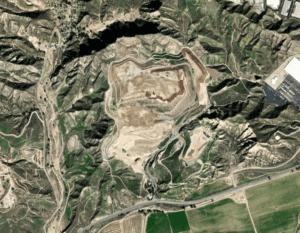
An aerial view of Chiquita Canyon Landfill.
Ongoing Response at Chiquita Canyon Landfill
BACKGROUND
Chiquita Canyon Landfill is a 639-acre municipal solid waste landfill in Los Angeles County that is operated by Chiquita Canyon, LLC, Chiquita Canyon, Inc., and Waste Connections US, Inc. (Waste Connections) and has served the county since 1972.
Since approximately May 2022, the site has been experiencing a heat-releasing chemical reaction deep within an inactive portion of the landfill, which has since grown in size. This reaction is causing several issues for nearby residents, including noxious odors drifting offsite that have generated thousands of complaints. The reaction is also producing additional liquids – called leachate – that must be pumped out of the reaction area. This leachate has been found to contain high levels of a dangerous chemical called benzene l that can harm public health and the environment. To avoid such harm, the leachate must be managed as a hazardous waste.
MULTI-AGENCY OVERSIGHT
Local, state, and federal agencies have been collaborating to address concerns about the operations and overall state of the landfill and have issued orders requiring action to address on-going environmental violations.
In November 2023, local, state, and federal agencies formed a Multi-Agency Critical Action Team (MCAT) to coordinate investigations and enforcement efforts and to ensure compliance with laws protecting public health and the environment. The task force includes: U.S. EPA, California Environmental Protection Agency and five of its entities, CalRecycle, the California Department of Toxic Substances Control, the Los Angeles Regional Water Quality Control Board, the California Air Resources Board, and the Office of Environmental Health Hazard Assessment; the South Coast Air Quality Management District; and the Los Angeles County Departments of Public Works, Public Health and Planning. The Los Angeles County Department of Public Health Solid Waste Management Program is certified to act as the Local Enforcement Agency (LEA) by CalRecycle.
Please find more information in the sections below.
Roles and actions of CalEPA entities
CalEPA’s Role and Actions CalEPA consists of six boards, departments, and office that are charged with restoring, protecting and enhancing the environment to ensure public health, environmental quality and economic vitality. The California Air Resources Board (CARB), CalRecycle, the Department of Toxic Substances Control (DTSC), the Los Angeles Regional Water Quality Control Board (part of the State Water Resources Control Board), and the Office of Environmental Health Hazard Assessment (OEHHA) play a role in regulating the Chiquita Canyon Landfill. CalEPA helps ensure enforcement and compliance activities are consistent, effective and coordinated.
The following information will continue to be updated with new actions taken by CalEPA and its involved entities.
California Department of Resources Recycling and Recovery (CalRecycle)
Role
Non-hazardous solid waste facilities throughout California are regulated by CalRecycle-certified solid waste Local Enforcement Agencies (LEA). For Chiquita Canyon Landfill (CCL), the Los Angeles County Public Health Department serves as the LEA.
CalRecycle oversees LEA performance and provides technical and enforcement guidance to LEAs and technical assistance regarding landfills to other regulatory agencies, including the Los Angeles Regional Water Quality Control Board (LARWQCB) and the South Coast Air Quality Management District (SCAQMD).
CalRecycle certifies local jurisdictions to act as the LEA, allowing local jurisdictions to retain oversight over local solid waste matters. In jurisdictions where CalRecycle has not certified an LEA, CalRecycle acts as the enforcement agency. Where a certified LEA is in place, CalRecycle has limited ability to take direct enforcement action. In these cases, the LEA holds the primary enforcement authority.
Key Actions
Compliance Order and Appeals (May 2025 – Ongoing)
- May 1, 2025 – The LEA issued a compliance order requiring CCL to:
- Install a geomembrane cover over reaction areas
- Relocate leachate Tank Farm 9
- Construct a physical barrier to prevent reaction spread into Cell 8A
- Install five new temperature monitoring probes by August 4, 2025
- May 15, 2025 – CCL appealed and requested a stay. CalRecycle’s director denied the stay on May 20, 2025.
- November 20, 2025 – The LEA modified its May 1 order, issuing directives requiring CCL to:
- Install geomembrane cover over the entire Main Canyon Waste Management Unit by August 31, 2026
- Install additional temperature monitoring probes
- December 19, 2025 – CCL appealed and requested a stay. CalRecycle’s director denied the stay on December 23, 2025.
- May 1, 2026 – The Los Angeles County Solid Waste Facilities Hearing Board unanimously affirmed the LEA’s order.
- May 11, 2026 – CCL appealed the hearing board’s decision to CalRecycle. The LEA and CCL submitted records, briefs, and responses from May 24 to July 23, 2026.
- August 28, 2026 – CalRecycle’s director upheld the LEA’s order. On September 28, 2026, CCL filed a petition in superior court seeking to overturn CalRecycle’s decision and to obtain a stay on the underlying enforcement order.
Inventory of Solid Waste Facilities That Violate State Minimum Standards
(February 2024 – Ongoing)
- LEAs enforce solid waste laws under Title 27 of the California Code of Regulations (27 CCR) and the California Public Resources Code that require solid waste facilities to operate safely, prevent nuisance conditions, protect public health, and maintain their infrastructure. Because CCL has not been able to contain the SET event and the resulting environmental releases, the landfill is not being kept in reasonable repair as required by 27 CCR section 20750.
- The LEA issued violations for:
-
- Gas monitoring and control standards (27 CCR section 20921) first cited during inspection on September 1, 2023
-
- Site maintenance standards (27 CCR section 20750) first cited during inspection on November 28, 2023
- February 28, 2024 – CalRecycle notified CCL of potential placement on the Inventory of Solid Waste Facilities That Violate State Minimum Standards (Inventory) if violations were not corrected within 90 days.
- May 15, 2024 – After the LEA confirmed the violations remained uncorrected, CalRecycle placed CCL on the inventory.
CCL remains listed. CalRecycle continues coordinating with the LEA, which conducts monthly inspections and provides updates on corrective actions.
Solid Waste Facility Permit Review
- A landfill’s Solid Waste Facility Permit (SWFP) is required to be reviewed at least every five years by the LEA. For CCL, the five-year review was due October 18, 2026. The LEA requested submittal of permit review application materials by March 29, 2026.
- August 31, 2026 – The LEA received from CCL a revised Closure Plan and Post-Closure Maintenance Plan with financial assurance information. The LEA, CalRecycle, and the Regional Water Quality Control Board are reviewing the submissions.
- As of October 20, 2026, the LEA has not received the 5-Year Permit Review Application or the Non-Water Release Corrective Action Plan.
Continued Technical and Enforcement Guidance (December 2023 – Ongoing)
- December 2023 – U.S. EPA Region 9 established a multi-agency coordination group to support enforcement, resolve technical issues, and coordinate public information. CalRecycle is an active member.
- February 2024 – U.S. EPA Region 9, CalEPA, and Los Angeles County established the Response Multi-Agency Coordination Group (RMACG) to oversee the operator’s response. The RMACG oversight functions have since transitioned back to the Multi-Agency Critical Action Team (MCAT), in which CalRecycle participates in the Environmental Unit along with the LEA, LARWQCB, DTSC, and the Los Angeles Department of Public Works.
Multiagency Site Visits (November 2023 – ongoing)
- November 2, 2023 – Joint site visits by the LEA, CalRecycle, SCAQMD, LARWQCB, DTSC, and U.S EPA Region 9.
- May 23, 2024 – Follow-up site visit by CalRecycle, the LEA, and U.S. EPA to support review of the slope stability report.
- April 27, 2026 – Site visit by the LEA and CalRecycle in preparation for a hearing.
- September 18, 2026 – Site visit by the LEA and CalRecycle to observe site conditions and the west slope toe berm construction.
CalRecycle Technical Assistance (October 2023 – Ongoing)
CalRecycle provides ongoing technical assistance on topics including cover systems, slope stability, reaction containment, temperature monitoring, infrared surveys, landfill gas, and odor control.
Technical Responses (Chronological)
2026
- Ongoing analysis of temperature and cover-integrity data for the MCAT Environmental Unit
- January 23 letter to DTSC: Additional comments on draft removal action workplan (covered area extension)
- January 9 letter to the LEA: Comments on global stability study workplan
2025
- December 2 Additional comments on the letter to the LEA: Additional comments on draft removal action workplan (covered area extension)
- October 3 Technical review of letter to the LEA: Review of directive 4.1 (geomembrane cover schedule) and directive 4.2 (relocation of Tank Farm 9)
- September 23 letter to the LEA: Review of directive 4.3 (soil barrier/thermal block for Cell 8A)
- September 12 letter to DTSC: Comments on draft removal action workplan to protect Cell 8A
- June 26 letter to DTSC: Comments on draft removal action workplan (covered area extension)
- March 28 letter to the LEA: Review of November 26, 2024, revised soil reaction break/barrier plan
- February 26 consultant memorandum: Comments on November 26, 2024, revised soil reaction break/barrier plan and February 20, 2025, waste temperature data
2024
- November 25 letter to the LEA: Technical review of forward looking infrared (FLIR) aerial survey
- September 25 letter to the LEA: Notification criteria for temperature monitoring probes
- September 20 letter to the LEA: Review of July 8, 2024, revised soil reaction break/barrier plan
- September 16 letter to the LEA: Technical review of September 6, 2024, east side soil barrier conceptual submittal
- September 4 letter to the LEA: Review of west and north slope stability analysis update
- July 8 letter to the LEA: Review of mitigation measure No. 5 and June 6, 2024, carbon monoxide and hydrogen reading summary
- July 2 consultant memorandum: Review of May 7, 2024, report on west and north slope stability analysis update
- April 18 email: Soil reaction break/barrier plan
- March 12 letter to the LEA: Review of mitigation measure No. 3 (slope stability analysis)
- January 12 letter to the LEA: Review of mitigation measure No. 2A (use of pressure relief valves)
2023
- December 28 letter to the LEA: Review of stability analysis workplan
- December 22 letter to the LEA: Review of mitigation measure No. 1B (reaction area temperature monitoring plan)
- December 20 letter to the LEA: Review of mitigation measure No 2A (cover options)
- December 12 letter to the LEA: Review of odor control options
- November 14 letter to the LEA: Review of CCL response letter
- October 16 letter to the LEA: Review of odor incident at CCL
Visit CalRecycle’s Chiquita Canyon Sanitary Landfill webpage for more.
*CalRecycle’s Solid Waste Information System (SWIS) provides detailed site information on operating and closed landfills in the state, including up to date links.
California Department of Toxic Substances Control (DTSC)
Role
The Department of Toxic Substances Control (DTSC) has regulatory authority over facilities in California related to hazardous waste management, ensuring compliance with environmental laws, conducting inspections and overseeing cleanup activities if contamination is detected. DTSC monitors the management, handling, treatment and disposal of toxic substances and investigates violations of California’s Hazardous Waste Control Laws.
As part of a multi-agency response effort, DTSC has determined that an uncontrolled, underground chemical reaction with elevated temperatures at Chiquita Canyon Landfill is generating massive amounts of hazardous liquids and gases, including benzene – a known carcinogen – and other air contaminants with noxious odors.
As a result of mismanagement of hazardous waste onsite, DTSC has issued several violations to Chiquita Canyon, LLC, Chiquita Canyon, Inc., and Waste Connections US, Inc. (Waste Connections) as described below. In addition, DTSC determined that conditions pose a threatened release of hazardous substances that presents an imminent and substantial endangerment to public health and the environment.
In coordination with state, federal and local partners, DTSC continues to investigate Waste Connections’ management of hazardous waste and is working to ensure CCL complies with the law and takes appropriate steps to protect public health and the environment.
Key Actions
Imminent and Substantial Endangerment Order:
- On April 1, 2025, DTSC issued an Imminent and Substantial Endangerment Order to Waste Connections.
- The order outlines that these entities’ actions have created an imminent and substantial danger of a release of hazardous leachate that could harm public health and the environment.
- It requires the landfill to (1) relocate the tank farm, (2) expand a geosynthetic cover to encompass the entire main canyon waste mass, (3) install a vertical reaction barrier at the southern portion of the landfill and (4) conduct additional monitoring, maintenance and reporting activities to manage the reaction.
- December 12, 2025: DTSC issued a Notice of Potential Noncompliance to landfill operators for failure to provide data as required by the ISE Order.
- December 26, 2025: DTSC issued a separate Notice of Potential Noncompliance to the operators for failure to submit approvable workplans under the ISE Order.
- January 26, 2026: DTSC issued a Final Determination of Noncompliance to landfill operators regarding their failure to submit approvable workplans under the ISE Order.
- June 3, 2026: DTSC and U.S.EPA issued a Joint Letter directing Waste Connections to identify a new location for a tank farm currently located on top of waste that could be vulnerable to the subsurface elevated temperature event. A second Joint Letter was sent on June 26, 2026.
- June 25, 2026: DTSC issued an Adequacy Letter indicating the Draft Cover Removal Action Workplan with modifications is suitable for public comment. The Adequacy Letter modified the Draft Cover Removal Action Workplan to expand the geosynthetic cover to all areas of the landfill in which the reaction has expanded or has the potential to expand and to comply with the earliest applicable schedule from other regulators.
- October 27, 2026: DTSC filed a lawsuit against Chiquita Canyon, LLC, Chiquita Canyon, Inc., and Waste Connections US, Inc (Waste Connections). The lawsuit alleges that Waste Connections has failed to comply with the California Hazardous Waste Control Law, violated the state’s Unfair Competition Law and polluted, impaired or destructed California’s natural resources. The lawsuit brings
a dozentwelve causes of action, including failure to minimize the possibility of unplanned spills of hazardous waste, unlawful storage of hazardous waste, failure to provide accurate information about the transport of hazardous waste, and conspiring to engage in unfair competition.
Summary of Violations:
February 25, 2026: DTSC issued a Summary of Violations for:
- Failing to minimize the possibility of release of hazardous waste.
- Transferring custody of hazardous waste to transporters without valid registration with DTSC.
November 18, 2025: DTSC issued a Summary of Violations for:
- Failing to minimize the possibility of release of hazardous waste.
- Failing to properly complete hazardous waste manifests.
- Failing to properly label tanks accumulating hazardous waste.
April 1, 2025: DTSC issued a Summary of Violations for:
- Failing to minimize the possibility of release of hazardous waste or hazardous waste components. Failing to comply with land disposal restriction requirements.
March 29, 2024: DTSC issued a Summary of Violations for:
- Failing to minimize the possibility of releases of hazardous waste or constituents by not utilizing all resources to demonstrate immediate response and failing to utilize permitted hazardous waste treatment, storage, and disposal facilities.
- Disposing of hazardous waste leachate at unauthorized locations.
- Experiencing a release of hazardous waste leachate due to a ruptured hose during treatment processes, causing an employee injury and violating regulations regarding hazardous waste disposal and containment.
March 1, 2024: DTSC issued a Summary of Violations to an offsite disposal facility called Avalon, owned by the Radford Alexander Corporation, for accepting hazardous waste from the landfill without the necessary permit. Avalon is an offsite disposal facility for nonhazardous waste and is not authorized to accept hazardous waste like the leachate sent there for disposal from Chiquita Canyon Landfill. Such hazardous waste must go to permitted facilities for safe disposal to protect the public health and safety and the environment.
Feb. 15, 2024: DTSC issued a Summary of Violations for failure to properly treat, store and dispose of hazardous waste as required by law and failure to operate in a way that minimizes the possibility of an unauthorized discharge of hazardous waste.
Learn more on the DTSC Chiquita Canyon webpage.
Los Angeles Regional Water Quality Control Board
Role
The Los Angeles Regional Water Quality Control Board (Los Angeles Water Board), one of nine semi-autonomous regional boards under the State Water Resources Control Board umbrella, regulates the Chiquita Canyon Landfill (the landfill) through issuance and oversight of three permits:
- waste discharge requirements to protect water quality from disposal of solid wastes to land, including provisions for landfill leachate and landfill-gas condensate containment and groundwater monitoring.
- a General National Pollutant Discharge Elimination System (NPDES) permit to protect water quality from stormwater runoff associated with industrial activities, including provisions for effluent limits, non-stormwater discharge prohibitions, pollution prevention, and monitoring.
- a General NPDES permit to protect water quality from stormwater runoff associated with construction activities, including provisions for non-stormwater discharge prohibitions, pollution prevention, and monitoring.
The regional board reviews pollution prevention plans and monitoring reports, conducts inspections to determine compliance with permit provisions, and takes enforcement action for violations of permit provisions as necessary.
Key Actions
- Investigative Order
- On June 12, 2026, the Los Angeles Water Board issued an investigative order for surface and groundwater monitoring that supersedes the March 2024 investigative order, which required the landfill operator to submit technical reports and conduct additional monitoring and reporting. The June 2026 order requires additional groundwater monitoring on the western slope of the landfill and updates the required detection limits for laboratory analysis of groundwater and surface water samples. The June 2026 order was issued as a final order.
- Letter directing measures to protect water quality
- On March 20, 2026, the Los Angeles Water Board issued a letter to the landfill outlining the board’s specific water quality concerns related to the subsurface elevated temperature event. The letter requires the landfill to (1) ensure slope stability to prevent a catastrophic release of solid waste and leachate and develop contingency measures in the event of such a release to protect ground and surface water; (2) install a groundwater containment system to ensure landfill contaminants are not released to groundwater; and (3) clean out and line the south and east stormwater basins.
- January 2026 — Notice of Violation
- On January 6, 2026, the Los Angeles Water Board issued a Notice of Violation in connection with an incident that began on November 14, 2025, and continued through December 2025. The incident started with a line break that resulted in 8,000 gallons of hazardous untreated leachate leaking from a pipe at the landfill, commingling with stormwater, and being pumped into the east stormwater basin before overflowing the basin into Castaic Creek and then flowing into Reach 5 of the Santa Clara River in a subsequent storm event.
- Denial of request:
- On September 25, 2024, to protect groundwater under the landfill in Castaic, the Los Angeles Water Board reaffirmed its June 2024 decision denying Chiquita Canyon LLC’s request to place waste in Cell 8B. The board determined that information submitted by the landfill operator was inadequate to address impacts from the ongoing development of individual cells within the landfill.
- Notice of Violation:
- On June 27, 2024, the Los Angeles Water Board issued a Notice of Violation to the landfill operator for alleged violations of the investigative order issued on March 20, 2024, including the failure to submit certain technical reports and monitoring and reporting data. The notice directs the landfill to submit the late and missing information to establish compliance.
- Notice of Violation:
- On April 9, 2024, the Los Angeles Water Board issued a Notice of Violation to the landfill operator after investigating multiple complaints from citizens. The notice documents violations of the company’s industrial stormwater permit, including unauthorized discharges. Videos and pictures from citizen complaints show water being pumped from the south detention basin into a local waterway that flows into the Santa Clara River. Violations for failing to fully complete the Stormwater Pollution Prevention Plan were also cited. The notice directs the landfill operators to cease the unauthorized discharges, undertake corrective measures and, by May 9, 2024, submit a written response identifying those actions.
- Notice of Violation:
- On March 28, 2024, the Los Angeles Water Board issued a Notice of Violation to the landfill operator for failing to comply with its industrial stormwater permit. The notice documents violations observed by staff during January 29. 2024, and February 20, 2024, inspections, along with those identified through sampling data submitted by the landfill. The notice directs the landfill operator to take immediate action to correct the alleged permit noncompliance, including the installation of additional best management practices.
- Investigative Order:
- On March 20, 2024, the Los Angeles Water Board issued an investigative order requiring the landfill operator to submit technical reports and additional monitoring and reporting. The order also required the landfill operator to install additional groundwater monitoring wells and conduct sampling of all discharges into the sedimentation basin.
- 2023-2024 Storms:
- Los Angeles Water Board staff conducted multiple inspections during the storms to determine if the landfill was effectively implementing best management practices and preventing stormwater contamination from leachate. However, contaminated stormwater may have exited the landfill during the storm events
- In advance of storms in December 2023 and January–February 2024, Los Angeles Water Board staff directed the landfill operator to prevent leachate from mixing with stormwater and exiting the site.
- Notice of Violation:
- On November 22, 2023, the Los Angeles Water Board issued a Notice of Violation to the landfill operator for violating its waste discharge requirements by failing to maintain adequate leachate containment and report a leachate seepage as a result of the SET event. The notice required the operator to submit a report on all corrective actions taken to mitigate the waste discharge violations by December 22, 2023, and submit a final compliance report by February 20, 2024. Both reports described the temporary measures to manage and contain the leachate and permanent steps to repair the landfill liner.
California Air Resources Board (CARB)
Role
The California Air Resources Board (CARB) is charged with protecting the public from the harmful effects of air pollution and oversees efforts to attain and maintain health-based air quality standards. As a member of the Chiquita Canyon Landfill technical advisory task force, CARB provides its expertise and support to South Coast Air Quality Management District, the local air district with primary authority over non-moving (stationary) sources of air pollution such as Chiquita Canyon Landfill. CARB staff helps communicate technical information with affected community members in approachable ways and participates in the technical subcommittee meetings to facilitate effective information sharing. CARB may also provide litigation assistance, air monitoring, and investigative support, upon request, to aid local air district enforcement actions.
CARB also oversees the state’s Landfill Methane Regulation which was updated in 2025 to enable quicker detection and repair of methane leaks at landfills, improve monitoring and reporting, and facilitate stronger action for recurring issues. Through a Memorandum of Understanding with South Coast Air Quality Management District, CARB provides enforcement support to the district to ensure landfill owners and operators comply with the rules. Requirements include installing and optimally operating landfill gas collection and control systems to minimize emissions, monitoring surface methane concentration and other performance parameters, repairing emission exceedances and other performance issues, conducting source testing of combustion devices used to destroy methane, keep records of these actions and data, and reporting compliance information to CARB and local air districts.
Office of Environmental Health Hazard Assessment (OEHHA)
Role
OEHHA’s mission is to protect and enhance the health of Californians and our state’s environment through scientific evaluations that inform, support, and guide regulatory and other actions.
As a part of the Multi-Agency Coordination Team, OEHHA participates in the public health assessment subunit and provides expertise in evaluating human health hazards from chemical exposures resulting from landfill emissions. OEHHA attends monthly Community Advisory Committee meetings and presents updates to the community as needed.
Throughout the response, OEHHA has analyzed air monitoring data and compared it to available health guidance values, reviewed risk assessment reports to determine potential health impacts, and advised on precautionary measures that residents can take to minimize their exposures. OEHHA is committed to continuing to engage in response efforts to support local agencies and the impacted community.
Federal and local partners addressing the Chiquita Canyon Response
